


The Anambra State Government has disclosed details of external loans it says were contracted during the administration of former governor Peter Obi, putting the total at $123.77 million.
The disclosure forms part of an escalating dispute over the financial record of Obi’s eight-year tenure and the liabilities inherited by subsequent administrations.
READ ALSO: 2027: Peter Obi Rejects Claim He Turned Down Atiku’s Running Mate Offer
According to the state government, the $4.05 billion figure represents the value of expenditures recorded during Obi’s eight years in office after the audited figures were converted using the average official exchange rates applicable during the period.
It said that applying the current official exchange rate to the same expenditure would produce a figure of about N5.4 trillion.
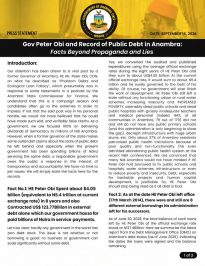
“Yes, we converted the audited and published expenditures using the average official exchange rates during the eight years of HE Peter Obi and they sum to about US$4.05 billion. At the current official exchange rate, it would sum to about N5.4 trillion and he surely governed to the best of his ability,” the government said.
The government stressed that the existence of public debt should not, by itself, be viewed as evidence of poor financial management, arguing that borrowing is commonly used to finance development by governments and businesses.
“Let’s be clear: hardly any government in the world has zero debt stock. The issue is not whether or not borrowing is good: no business or government can scale significantly without some debt,” it said.
However, the state government questioned what it described as gaps in infrastructure and public services at the end of Obi’s tenure, citing water supply, education, healthcare, security and poverty.
“Of course, no government will ever finish the work of development. HE Peter Obi still left a state without any functioning urban or rural water schemes; increasing insecurity and INCREASED POVERTY, ostensibly dead public schools and dead public hospitals with grossly inadequate teachers and medical personnel (indeed 44% of all communities in Anambra, 78 out of 179) did not and still do not have any public primary schools (and this administration is only beginning to close the gap), decrepit infrastructure with huge urban slums, etc.”
The government also made claims about public healthcare utilisation during the period.
“Only about 27% of Anambra residents patronized public health institutions because of poor quality and non-functionality (he even admitted abandoning public health system at the recent NBA conference),” it said.
The state government argued that borrowing could have been justified if the funds had been directed towards projects capable of producing measurable development outcomes.
“We are convinced that many Ndi Anambra would not have minded if HE Peter Obi had borrowed to fix public schools and hospitals, water schemes, infrastructure, or even to reduce poverty and insecurity, Debt, especially for bankable projects and human capital development, is justifiable. So, HE Peter Obi should stop being irked as if all debt is bad.”
The dispute comes as the Anambra government continues to challenge claims that Obi handed over the state without outstanding financial obligations. The government has said some of the loans contracted during his tenure remained outstanding and were still being serviced by the state.
Obi, for his part, has rejected the allegations and maintained that his administration cleared substantial inherited liabilities before leaving office.
The competing accounts have intensified the debate over the former governor’s financial record and the extent of liabilities inherited by successive administrations.


