

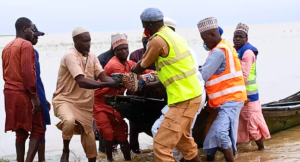
At least 60 people have died and many others rescued after a passenger boat capsized in Niger State, located in north-central Nigeria, local officials confirmed on Tuesday.
The vessel, carrying more than 100 passengers, departed from Tungan Sule in the Malale district around 11 a.m. local time, bound for Dugga town on the Kainji Reservoir, when the accident occurred.
READ ALSO: 10 Perish, 40 Missing In Sokoto Boat Tragedy!
Sa’adu Inuwa Muhammad, district head of Shagumi, reported arriving at the scene shortly after the incident. “We were able to recover 31 corpses from the river. The boat was also recovered and removed.” By Tuesday evening, the death toll had risen to over 60, with dozens of survivors pulled from the water.
Most of the deceased were women and children, Muhammad added. Four victims were buried the same day following Islamic burial customs.
While the exact cause remains unknown, locals suggest the boat was overloaded and may have struggled against strong currents. Witnesses said passengers included farmers and traders traveling to Dugga for business and market activities.
Passenger boats are a common mode of transport in Nigeria’s riverine areas, especially where road access is limited. However, these boats are often overcrowded, poorly maintained, and lack essential safety gear like life jackets.
Residents reported that the boat was carrying far beyond its safe capacity. Vessels designed for 50 to 60 passengers sometimes transport over 100 people, along with goods and livestock, increasing accident risks.
“Many people rely on these boats because they are cheaper and faster, but safety is not guaranteed,” one resident said. “There were so many people inside, including women and children. That is why the casualties are so high.”
Survivors recounted the boat began to sway shortly after departure. “It tilted suddenly and before we knew it, water rushed in and the boat went down,” one said. Panic ensued, with many jumping into the river, worsening the situation.
Without life jackets, most struggled to stay afloat. Nearby villagers rushed with canoes to assist, but many had drowned before help arrived.
Boat accidents are frequent in Nigeria, especially during the rainy season when rivers swell and currents strengthen. Poor regulation, aging vessels, and lax enforcement of safety rules contribute to these tragedies.
Similar incidents have claimed many lives in Kebbi, Sokoto, and Niger states in recent years. In May 2021, over 100 people died in Kebbi when a boat carrying more than 160 passengers capsized. Last year, a boat accident in Anambra State killed at least 70.
Local authorities and emergency teams are conducting search and rescue operations, though limited resources hamper efforts. The Niger State Emergency Management Agency confirmed ongoing efforts to locate all passengers.
Officials have called for additional boats and divers to aid recovery and urged communities along the Kainji Reservoir to help search for missing persons possibly swept downstream.
The state government expressed sorrow over the tragedy and pledged to investigate its cause. Authorities also promised stricter enforcement of safety regulations for boat operators to prevent future incidents.
For the victims’ families, the disaster has caused immense grief. Many deceased were women and children reliant on farming and petty trade. Some households lost multiple members.
A villager whose sister and two nieces perished described the day as “a dark day for our community.” The victims had been traveling to Dugga to sell farm produce.
Community leaders and advocacy groups have renewed calls for government prioritization of river transport safety, emphasizing that many such tragedies are preventable through strict regulation, monitoring, and mandatory life jackets.
“Boats should not be allowed to carry more than their capacity, and every passenger should have a life jacket,” one activist said. “We cannot continue to lose lives to accidents that are preventable.”
Experts also recommend improving rural infrastructure like roads and bridges to reduce reliance on risky boat travel.
Currently, efforts focus on recovering remaining bodies and supporting survivors and bereaved families. The tragedy highlights the dangers faced by rural communities dependent on water transport due to lack of safer alternatives.


