

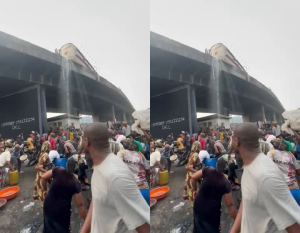
The Lagos State Fire and Rescue Service (LSFRS) has attributed the tanker accident on the Apapa-Oshodi Motorway to brake failure.
The News Agency of Nigeria (NAN) recalled that firefighters prevented a potentially catastrophic incident on Monday after a fuel tanker was involved in an accident near Liverpool Bridge along the Apapa–Oshodi axis at Tin Can Island.
Speaking to journalists on Monday evening, the Controller General of the LSFRS, Mrs Margaret Adeseye, confirmed that the tanker lost control before veering off the bridge.
READ ALSO: Danger As Residents Scoop Fuel From Fallen Tanker In Lagos
She explained that the agency received an emergency alert around 8:05 a.m. regarding a salvage operation involving a Mack trailer tanker, registration number RBC 98 XK, which was transporting 45,000 litres of diesel.
“The tanker lost control while in motion, skidded off the bridgeway and was left hanging precariously on the bridge rail.
“The incident also resulted in a partial spillage of diesel on the bridge, underneath the structure, and into an adjoining drainage channel, raising concerns about a possible fire outbreak or environmental hazard.
“Firefighting crews from the Ajegunle and Sari Iganmu Fire Stations were immediately deployed to the scene,” she said.
Adeseye noted that firefighters promptly stabilised the tanker, preventing it from falling and stopping any escalation.
“The situation was swiftly brought under control, with all imminent danger completely averted.
“As part of the emergency response, the remaining diesel in the tanker was safely transloaded, while the area was secured to prevent interference by fuel scoopers,” she said.
She added that once the decanting process was completed, the tanker was successfully removed from the scene.
According to her, traffic flow has since returned to normal on the heavily used roadway.
Adeseye praised the efficiency and professionalism of the emergency responders, stressing that their quick intervention averted what could have been a major disaster.
She also urged motorists—especially operators of heavy-duty vehicles—to prioritise routine vehicle maintenance to reduce the risk of similar incidents.


