

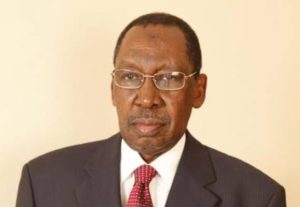
Justice Mohammed Lawal Uwais, a distinguished former Chief Justice of Nigeria (CJN), has passed away at the age of 89.
His death was confirmed by a family source, who disclosed that the eminent jurist died on Friday, June 6, 2025, in Abuja. Preparations for his Janazah (funeral prayer) and interment are currently ongoing.
Born on June 12, 1936, Justice Uwais was appointed as Nigeria’s Chief Justice in 1995 and held the position until his retirement in 2006. Over the course of his judicial career, he earned widespread recognition for his unwavering commitment to justice, integrity, and the rule of law.
After retiring from the Supreme Court, he was entrusted by the late President Umaru Musa Yar’Adua with leading a pivotal national assignment—the Electoral Reform Committee. This appointment was a testament to the high regard in which he was held and the public confidence in his impartiality and intellectual depth.
Justice Uwais hailed from a prominent lineage, being the son of a former Chief Alkali and later Waziri of the Zaria Emirate. His early life and upbringing laid the foundation for a career marked by fairness and legal brilliance.
As head of the Electoral Reform Committee, Justice Uwais oversaw the development of a comprehensive set of recommendations aimed at improving Nigeria’s electoral framework. The committee’s report, submitted on December 11, 2008, offered far-reaching reforms, many of which remain central to national discussions on election integrity.
Among the notable proposals were:
The establishment of autonomous bodies to investigate and prosecute electoral offences.
The creation of independent commissions responsible for the delimitation of constituencies and regulation of political parties.
The adoption of a proportional representation system for elections at all tiers of government.
Perhaps the most controversial recommendation made by the committee was the suggestion that the appointment of the Chairman of the Independent National Electoral Commission (INEC) should be transferred from the President to the judiciary. This was intended to depoliticize the appointment process and enhance the credibility of the electoral body.
While the proposal sparked intense debate, it was ultimately rejected—first by President Yar’Adua and later by the Senate’s Constitutional Review Committee, which raised constitutional concerns about maintaining the separation of powers. Nevertheless, Acting President Goodluck Jonathan, in March 2010, forwarded the full, unedited version of the Uwais Report to the National Assembly, signaling a renewed interest in electoral reform ahead of the 2011 general elections.
The debate over who should appoint the INEC chairman remains unresolved to this day, with many legal scholars and political analysts still citing Justice Uwais’s recommendations as a blueprint for lasting reform.
Justice Uwais’s legacy is not confined to his judicial pronouncements or his post-retirement service. His enduring contribution lies in his principled stand on reform, transparency, and the democratization of Nigeria’s institutions.
Tributes have been pouring in from legal practitioners, political leaders, civil society actors, and ordinary citizens, all recognizing him as a paragon of justice and institutional integrity.
Justice Mohammed Lawal Uwais leaves behind a lasting legacy of ethical leadership and visionary reform. His contributions will continue to shape Nigeria’s legal and democratic journey for generations to come.


