

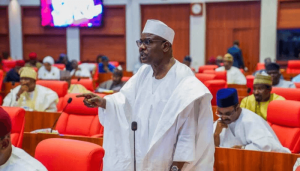
Senator Ali Ndume, a former Chief Whip of the Nigerian Senate, has advised President Bola Ahmed Tinubu to urgently address growing public dissatisfaction or risk a political downfall reminiscent of former President Goodluck Jonathan’s electoral defeat in 2015.
Ndume made these comments on Politics Today, a Channels Television current affairs program aired on Sunday.
During the interview, he drew stark comparisons between the present political climate and the environment that led to Jonathan’s loss, underscoring how political endorsements may not translate into electoral success.
READ ALSO: Ndume Retracts Criticism, Lauds Tinubu for Equitable Appointments to the North
“Tinubu could be given the Jonathan treatment because Jonathan also had 22 governors who endorsed him, like we did now. And what happened? Jonathan lost woefully,” the lawmaker remarked.
Jonathan, who ran as the People’s Democratic Party (PDP) presidential candidate in 2015, was widely backed by state governors and influential political figures. However, he was decisively defeated by Muhammadu Buhari, the All Progressives Congress (APC) candidate, who garnered over 15.4 million votes to Jonathan’s 12.8 million.
Representing the Borno South Senatorial District, Ndume emphasized that widespread backing within the APC should not be mistaken as a guarantee for re-election. He warned that Tinubu’s political future could be in jeopardy if the administration fails to respond effectively to the hardships Nigerians are facing.
“We are not learning our lesson,” Ndume cautioned, accusing party leaders of being complacent and out of touch with everyday realities.
“I pity Mr. President. Even though he once said this is not the time for campaigns, look around, the campaigning has already started under the guise of endorsements,” he added.
The senator further expressed his concerns over internal affairs within the ruling party, particularly in response to speculations about automatic tickets being granted to sitting lawmakers. He warned that such a move could alienate loyal party members who are critical for grassroots mobilization.
“When the rumour came that National Assembly members might get automatic tickets, the party denied it. So, who will be the foot soldiers? You cannot rely on governors alone,” he queried.
Ndume’s comments came amid rising tensions over Nigeria’s worsening economic situation, which has drawn criticism from various quarters. He urged President Tinubu to re-evaluate the administration’s priorities and pursue policies that directly alleviate the suffering of ordinary Nigerians.
“There’s still time to turn things around,” he said, noting that there remains a window for the president to restore public trust through meaningful reforms.
“If in the next two years, the president can make Nigerians happy, really happy, then nobody will contest against him,” Ndume asserted, suggesting that electoral success in 2027 will hinge on the administration’s ability to improve living conditions for the populace.
Beyond political strategy, the senator took aim at members of Tinubu’s inner circle, accusing some presidential advisers of misleading the president and contributing to a growing disconnect between him and ordinary citizens.
“My position is that the people who are supposed to help him are the ones deceiving him or damaging his image,” Ndume charged. “I see people lying and telling the president what he wants to hear.”
He didn’t hold back in criticizing the makeup of the current administration, claiming that it is populated by individuals more concerned with personal enrichment than public service.
“They are unrealistic people. I still believe the government is more or less dominated by kleptocrats and even kakistocrats,” he said.
Expounding further, Ndume explained, “Kakistocrats are people holding positions they are not supposed to be in, while kleptocrats are those in politics for personal gain, not public service.”
While refraining from naming specific individuals, the senator highlighted the growing alienation between Aso Rock and everyday Nigerians. He pointed out that the president is insulated from public sentiment and therefore may not grasp the severity of the public’s frustrations.
“The president cannot go out to the streets like I do and know how the people feel,” he said. “Even outside the villa, they would drive him in tinted glass so he doesn’t even see what is going on. People are not happy.”
He urged President Tinubu to rely more on the perspectives of legislators and grassroots leaders, who, he argued, are more attuned to the realities facing the masses.
“Intelligence should come from those who are close to the ground. Things are very bad in the country,” Ndume concluded.


