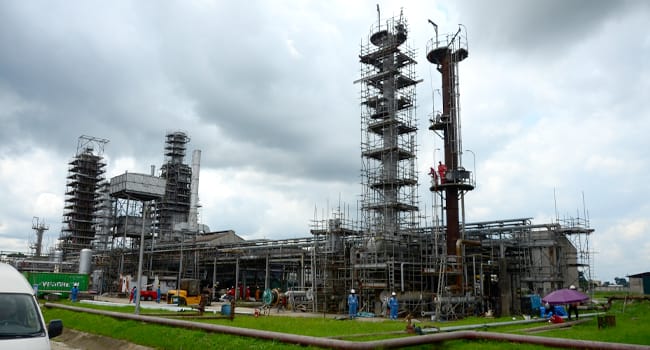
The Port Harcourt Refining Company in Rivers State has resumed its operations in accordance with the Federal Government’s commitment to ensuring the production of refined products at the facility by December 2023.
This development follows years of poor performance and maintenance efforts at the refinery.
Nigeria’s refineries in Port Harcourt, Warri, and Kaduna have a combined capacity to process 445,000 barrels per day (bpd), but they were closed down in 2019.
However, in August, Senator Heineken Lokpobiri, the Minister of State for Petroleum Resources (Oil), announced that the Port Harcourt refinery would resume operations in December.
Lokpobiri made this announcement while inspecting the rehabilitation work at the PHRC Ltd. plant.
“Our objective in coming here today is to ensure that in the next few years, Nigeria stops fuel importation. From what we have seen here today, Port Harcourt Refinery will come on board by the end of the year,” he said in August.
The Port Harcourt refinery has resumed operations after a hiatus of more than two years.
READ ALSO: Yuletide: Jubilation As President Tinubu Declares 50% Reduction In Transport Fare Nationwide
This follows the approval of $1.5 billion (1.2 billion euros) by the Federal Government for the repair of one of Nigeria’s largest oil refineries.
Maire Tecnimont, an Italian company, was selected by the government to undertake the necessary repairs at the Port Harcourt facility, which has a production capacity of approximately 210,000 barrels per day.
“We are happy to announce that the rehabilitation of productivity refinery will commence in three phases,” the then-Minister of Petroleum (State) Timipre Sylva told reporters.

“The first phase is to be completed in 18 months, which will take the refinery to a production of 90 percent of its nameplate capacity,” said Sylva, adding that the second phase would be completed in 24 months and the third in 44 months.
Nigeria, despite being Africa’s top oil producer, has faced the challenge of relying on petroleum imports due to a lack of domestic refining capacity.
This has resulted in frequent fuel shortages. However, the government has taken steps to address this issue by working on enhancing the capacity of the country’s underperforming state-owned refineries as part of the Nigerian National Petroleum Company Limited (NNPCL) overhaul.
The aim is to not only resume refinery operations but also initiate a similar process at the Dangote Refinery.
These efforts are expected to improve fuel supply in Africa’s largest oil producer and enable the country to save on refined fuel and other petroleum products.
Additionally, with the removal of fuel subsidies, this move is anticipated to have an impact on the product’s cost.