

By Afor Kenneth
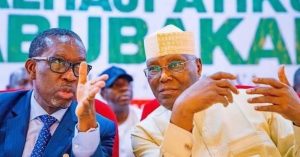
Former Delta State Governor and 2023 Vice Presidential candidate for the Peoples Democratic Party (PDP), Ifeanyi Okowa, has confirmed that his former principal, Atiku Abubakar, is planning to leave the party.
Okowa made this announcement during an interview on Arise TV on Tuesday, shortly after he and other PDP leaders in Delta State, including Governor Sheriff Oborevwori, officially switched their allegiance to the ruling All Progressives Congress (APC).
READ ALSO: Okowa Regrets Running With Atiku in 2023 PDP Presidential Bid
In the interview, Okowa disclosed that he had informed Atiku about the impending defection prior to the announcement.
He stated, “Actually, I did communicate with him that we’re going to have stakeholders meetings and I did communicate that we’re going to have the stakeholders meetings in this week, that is in the last week. And that it was going to be a leadership meeting and the outcome of that meeting was going to determine our next path because we are no longer comfortable with the PDP.”
Okowa further indicated that Atiku had already hinted at his departure from the PDP. “I also know that he was already heading out of the PDP from the communications that he has passed on to me and that have also, Nigerians also know already,” he remarked.
He explained that after discussions with political leaders in Delta, there was a near-unanimous decision to join the APC. “We’re looking into, could it be the APC, could it be the coalition… and it was a near-all decision that we should move into the APC,” Okowa noted.
On the topic of political rotation between the North and South, Okowa emphasized that while candidates from both regions emerge in various parties, it is crucial for national unity that President Bola Tinubu completes his term. “For the stability of Nigeria, it is best for us to have him complete his eight-year tenure. Then the presidency can move back to the North. I believe that that is the right thing,” he stated.
In response to the defections, Atiku Abubakar remarked that such movements are a normal aspect of democratic politics. Earlier in March, he had announced a political coalition aimed at challenging President Tinubu’s administration, with indications that he may run again in the 2027 presidential election.


