

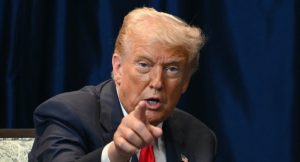
U.S. President Donald Trump announced on Thursday that he has directed the Pentagon to restart nuclear weapons testing, a move he says is necessary to match the growing programs of China and Russia.
His statement came just moments before he opened a crucial summit with Chinese President Xi Jinping in South Korea.
The order followed Russian President Vladimir Putin’s revelation a day earlier that Moscow had successfully tested a nuclear-powered underwater drone, reportedly in defiance of Washington’s objections.
“Because of other countries’ testing programmes, I have instructed the Department of War to start testing our nuclear weapons on an equal basis,” Trump posted on social media.
READ ALSO: Trump Threatens Hamas with Annihilation Over Gaza Truce Breach
Although the United States signed the Comprehensive Nuclear-Test-Ban Treaty (CTBT) in 1996, which prohibits all forms of atomic explosions for either civilian or military use, it remains unclear whether Trump was referring to testing nuclear warheads — last conducted by the U.S. in 1992 — or testing delivery systems capable of carrying such warheads.
Trump also boasted that the U.S. currently possesses the largest nuclear arsenal in the world, attributing this to his administration’s modernization efforts.
“Russia is second, and China is a distant third, but will be even within five years,” he added.
According to data from the International Campaign to Abolish Nuclear Weapons (ICAN), nine nations currently have nuclear weapons — Russia, the United States, China, France, the United Kingdom, Pakistan, India, Israel, and North Korea. Of the estimated 12,331 warheads in existence, about 5,500 are held by Russia, while 5,044 belong to the United States.
Speaking to journalists aboard Air Force One, Trump reflected on how long it had been since America last conducted a nuclear test.
“We don’t do testing… we’ve halted it years, many years ago,” he said, describing his new order as “appropriate” given other nations’ activities.
“I’d like to see denuclearisation… denuclearisation, would be a tremendous thing,” he added.
He further explained, “It’s something we are actually talking to Russia about, and China would be added to that if we do something.”
Trump did not disclose specific locations or dates for the new tests but earlier suggested they would “begin immediately.”
Following his remarks, China called on Washington to respect the CTBT and adhere to global disarmament norms.
“China hopes the United States will earnestly abide by the obligations of the comprehensive nuclear-test-ban treaty and its commitment to a ban on nuclear testing, and take concrete actions to safeguard the global nuclear disarmament,” said Foreign Ministry spokesman Guo Jiakun.
Between 1945 and 1992, the United States conducted 1,054 nuclear tests, alongside the two atomic bombings of Japan during World War II. The final nuclear explosion occurred in September 1992 at the Nevada Nuclear Security Site, following which President George H. W. Bush imposed a moratorium still observed today.
Since then, testing has been replaced with advanced computer simulations and subcritical experiments that do not produce nuclear explosions.
Meanwhile, Putin’s announcement of the “Poseidon” drone — a nuclear-capable underwater vehicle he claims is “impossible to intercept” — has heightened global concerns. He stated that the torpedo can travel faster and deeper than conventional submarines, capable of reaching any continent.
After Russia’s missile tests earlier in the week, Trump criticised Putin, urging him to “end the war in Ukraine instead of testing missiles.”
A scheduled meeting between both leaders in Budapest last week was later cancelled.


